
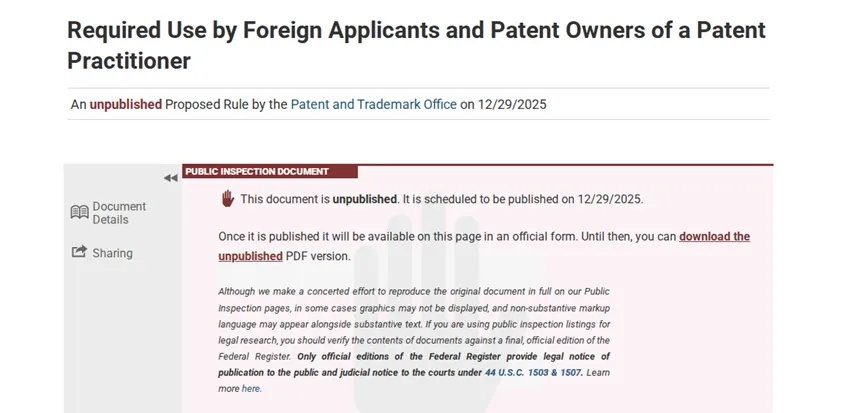
The United States Patent and Trademark Office (USPTO) plans to issue a key new rule on December 29, 2025. It requires patent and trademark applicants and right holders who are not resident in the US to entrust registered US patent attorneys to handle their US patent and trademark matters.
The USPTO will release the new rule on December 29, 2025. It makes it mandatory for all applicants and patent holders not resident in the US to hire registered US patent attorneys for their patent and trademark affairs. With this move, the USPTO can make better use of existing systems to ensure compliance with relevant US laws and regulatory requirements. It also responds to and takes proper actions against false certification, misleading statements and fraudulent acts.
The new rule will bring far-reaching impacts on foreign applicants, especially foreign enterprises and individuals from China and other countries, in many aspects:
1. A sharp rise in compliance costs
After the new rule takes effect, applicants must hire licensed US patent attorneys or agents. Both agency fees and hidden costs (such as translation, time zone coordination and understanding gaps) will rise significantly.
2. Increased complexity of application procedures
All official communications, responses to office actions, document revisions, fee payments and other operations must be handled by US agents. If the agency lacks professionalism or responds slowly, it may delay key deadlines such as replying to office actions and paying fees.
3. Mounting pressure on small and medium-sized enterprises and individual applicants
SMEs and independent inventors have limited budgets. The high agency fees charged by US firms may force them to abandon patent applications in the US, which indirectly weakens their ability to layout technologies globally. It becomes harder to “sail overseas by borrowing a boat” and test the US market at a low cost.
4. Faster formation of a “professional threshold”
In the future, the ability to effectively access the US patent and trademark system will largely depend on having stable and reliable US agency resources.
Facing the upcoming implementation of the USPTO’s new rules, ScienBiziP advises enterprises to adopt systematic and forward-looking strategies when laying out US patents and trademarks:
1. Establish a professional and compliant agency mechanism
Ensure that the agency and its agents are registered with the USPTO (qualifications can be verified via the USPTO official website). Prioritize professional teams with experience serving Chinese clients, a good grasp of technical term differences between China and the US, and prompt response capabilities. Avoid the risk of signature fraud caused by “nominal agents” or being added to the USPTO blacklist.
ScienBiziP’s US team was founded in 2016. All practicing staff are registered with the USPTO, with the right to sign documents and act as agents, fully complying with the new rule requirements. Led by senior ethnic Chinese patent attorneys and agents, the team has a deep understanding of the dual logic of Sino-US scientific and technological language and legal culture. It is committed to providing efficient, accurate and compliant full-process US intellectual property services for global innovators, especially applicants from China and the Asia-Pacific region.
2. Optimize internal preparations before application
Strengthen the writing strategy of “starting with the end in mind”. When drafting specifications and claims at the Chinese or PCT stage, take into account US patent law standards (such as the high requirements for support and definiteness under 35 U.S.C. §112). Eliminate ambiguous expressions, excessive functional limitations, insufficient examples and other issues to effectively improve the authorization rate and reduce subsequent costs of office action responses. Sort out information on “real parties in interest” in advance, and establish equity structure charts, lists of affiliated companies and explanations of core technology sources. If the application involves university projects, government projects or cross-border investment, prepare proof of fund sources and technology ownership to meet the possible disclosure requirements of the USPTO. Conduct a reasonable assessment of whether the enterprise qualifies as a micro-entity or small entity. ScienBiziP’s US team has rich experience in drafting and responding to applications in fields such as artificial intelligence, semiconductors, biomedicine, new energy, communications and mechanical engineering. It has an in-depth understanding of the specific requirements of US examination for different technical fields and can intervene early to help enterprises build high-quality and resilient patent applications from the source.
3. Build a regular internal IP compliance system
Set up a cross-departmental “USPTO Task Force” to centrally manage US patent and trademark matters. Conduct risk checks on existing applications and patents, formulate remedial plans in advance for high-risk cases, and organize regular training on US policies.
As a professional institution that set up an agency team in the US at an early stage, ScienBiziP adheres to integrating localized operations with efficient process management. It can provide enterprises with flexible and cost-effective solutions, and systematically transform external compliance requirements into internal executable and sustainable management practices.
Under the new rules, the success of response strategies is closely related to the professional capabilities, response efficiency and service models of enterprises and their agency teams. It is believed that by establishing a professional cooperation mechanism with internal and external coordination and systematic layout, Chinese enterprises will cross the new compliance threshold and gain sustainable intellectual property strategic advantages in the global innovation competition.