The CNIPA’s Measures for the Administration of Patent Priority Examination is about to take effect. How should enterprises adjust their priority examination strategies? ScienBiziP provides interpretation for you.
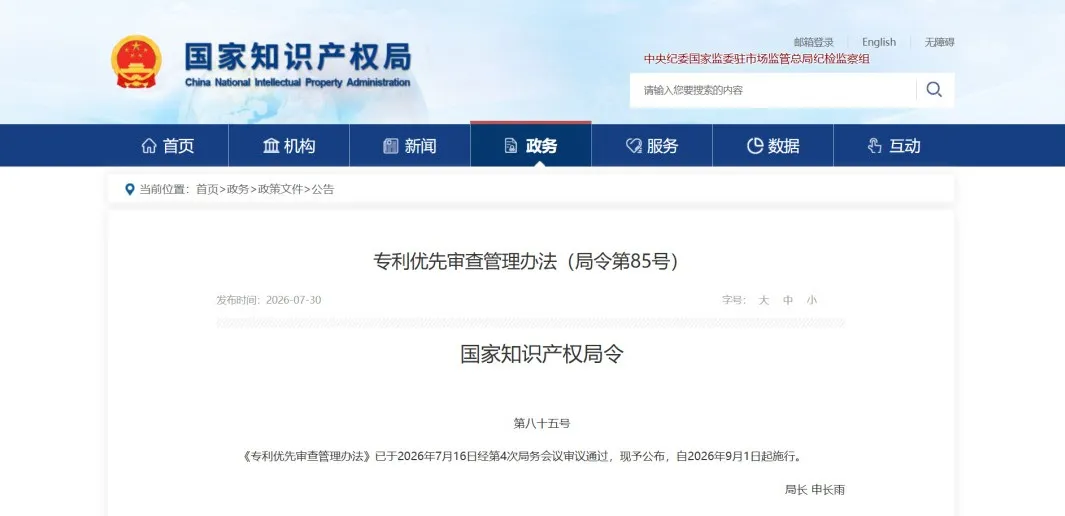
On July 30, 2026, the China National Intellectual Property Administration issued the new version of the Measures for the Administration of Patent Priority Examination, which shall come into force on September 1. This is not merely an adjustment expanding the number of provisions from 15 to 24, but a systematic transformation from “general speed-up” to “targeted services”. Under the new rules, the threshold for patent priority examination has changed, and service logics of patent agencies must be upgraded accordingly.
- Core Change: From “Prioritizing Speed” to “Prioritizing Quality”
The most notable change of the new measures lies in that the eligibility criteria for priority examination shift from listed industrial sectors to a focus on “innovative value + commercialization prospect”. Patent applications applying for priority examination must possess significant innovative value and clear prospects for transformation and application, and focus on emerging industries, future industries or key core technology research areas. This means that only “high-quality technologies” can access the fast track in the future, and examination resources will be precisely allocated to innovations with genuine strategic value.
Meanwhile, the new rules specify several circumstances where priority examination shall not be granted, such as divisional applications whose parent applications have already been accelerated, and “same-day filing” for invention and utility model patents. These previously existing “grey practices” in practice are officially blocked. In addition, the time limit for responding to office actions for invention patent applications is shortened from two months to one month from the issuance date, imposing higher requirements on the response speed of applicants and agencies.
- Implications for Enterprises: Reassess Priority Examination Strategies
For enterprises, the signal delivered by the new rules is clear and firm: priority examination is not a universal benefit policy, but an accelerator for high-quality innovation. If your technology falls in emerging fields, carries core research value and has definite industrialization prospects, this track remains efficient. If the patent lacks sufficient inventive height or has unclear commercialization prospects, a forced application may not only be rejected, but may also lead to an integrity sanction of “non-acceptance within one year” in case of false supporting materials.
- Our Response: Professionalism Is the Key to Securing the Window Period
Priority examination is never a simple submission of documents. Its essence is a comprehensive test of case quality, timing judgment and schedule control. As an agency consistently putting professional quality first, we have studied the new rules promptly and completed three service upgrades under the framework of the new rules:
First, more rigorous pre-filing assessment. Before submitting the priority examination request, we will assist you in judging whether the technology truly meets the requirements of “innovative value + commercialization prospect”, so as to avoid wasted opportunities caused by blind applications.
Second, more efficient procedural response. Targeting the one-month shortened response period, we have established special early warning and rapid response mechanisms. We accurately forecast examination milestones for clients in advance, plan the timing of priority declaration beforehand, track case status throughout the whole process, and prevent deadline failures.
Third, clearer compliance bottom line. The new rules strengthen service accountability and integrity requirements for patent agencies. When assisting in preparing materials such as industrialization evidence, we adhere to both professionalism and compliance.
Under the new rules, the window for priority examination has narrowed, raising higher requirements on the professional judgment and procedural management of patent agencies. ScienBiziP has years of practical experience in patent priority examination, with mature response mechanisms covering every step. If you are planning a priority examination route or want to evaluate whether your case qualifies for this track, feel free to contact us — we will provide you with practical assessment and suggestions based on the framework of the new rules.